




An Irish Jew has said he and his wife sometimes do not attend community events together because they fear a massacre would leave their young son orphaned.
Sunday Times journalist Jon Ihle has lived in Ireland for nearly 30 years, but grew up in a secular Jewish home in New York - a city where to be Jewish is not “in any way remarkable”.
That changed when he moved to Ireland and realised that his religion made him stand out in a country with a tiny population of Jews.
“When I came over here, I recognised something in me that was a difference that wasn’t fully explained by being an American,” he told The Claire Byrne Show.
“I think that that difference was partly how I was regarded because I was Jewish.
“Now, I wouldn't say that was entirely a negative experience, although it sometimes was.”
Ireland’s Jewish population peaked after the Second World War at around 5,000 members - roughly double the current number.
Although the community was spared the horrors of the Holocaust, Ireland has not been entirely free of antisemitism.
A boycott of Jewish shops in Limerick began in 1904, resulting in most families fleeing the city.
More recently, the community has begun documenting a surge in anti-semitic incidents in the wake the October 7th attacks, with Irish Jews reporting racist graffiti, slurs and threatening communications.
Given the recent attacks on Jews in Manchester, Sydney and London, Mr Ihle said he and his wife often wonder if they will be safe at Jewish community events in Dublin.
“In my household, the conversations we have before we attend a Jewish event, or where we're going to be in an area where lots of Jews are gathered, always involves some consideration of what the security is going to be like at that event, right?” he explained.
“Is it easy to escape from, for instance? Is this something that's appropriate to bring our six year old son to?
“If it's an event for adults, is one of us going to stay home in case something happens so that at least there's one of us who survives?”
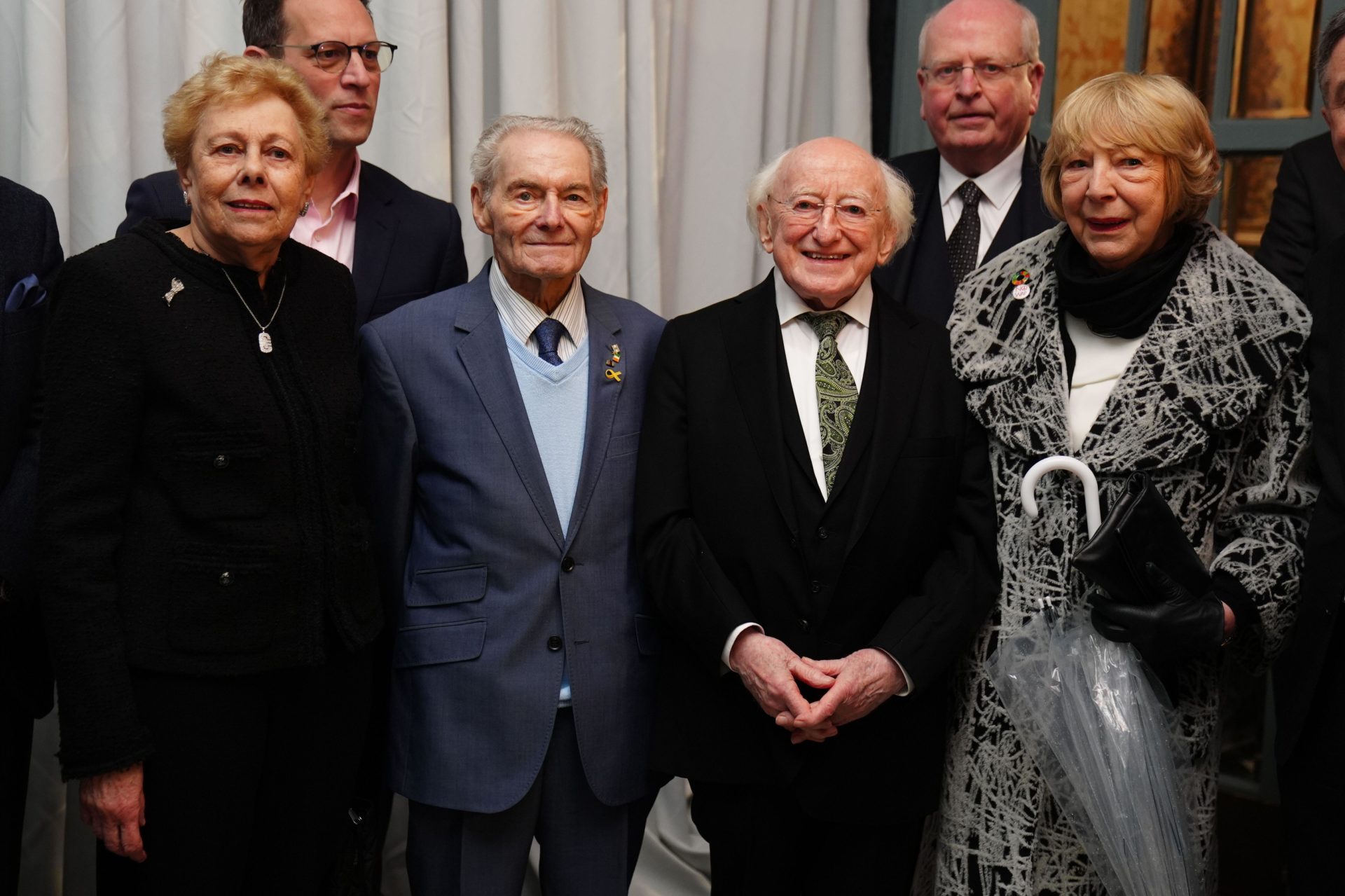 Michael D Higgins and his wife Sabina with Holocaust survivors Suzi Diamond and Tomi Reichenthal at a Holocaust Memorial Day event at the Mansion House in Dublin. Picture by: PA Images / Alamy.
Mr Ihle admitted to some that might sound “melodramatic”, but noted that Jewish communities across the world are living with a “regular drumbeat of violence”.
It is an atmosphere of fear that he feels has become tragically normalised.
“If there were another community that felt that sense of siege and that they had to take steps to protect themselves in moments where they're visible, I think there would be a sense of moral outrage about it,” he said.
“However, because the Jewish people are connected to Israel, it is somehow accepted as, ‘Well, this is just the price you pay because that country over there is behaving in a way that we find objectionable.’
“And that's the part that's very difficult to deal with.”
View this post on Instagram
One issue that is often raised when people discuss antisemitism is Jewish people’s attitude towards Israel and the tens of thousands of people who have died in the recent Gaza War.
On this topic, Mr Ihle feels that it is “almost impossible for Jews not to be connected to Israel”, given most have family or friends there.
Although not everyone feels the same way about the country, he believes it remains at the “centre of Jewish life”; however, he notes that diaspora Jews are distinct from Israelis.
“I'm not an Israeli, I don't vote in Israel, I don't live in Israel,” he said.
“So, the idea that I should somehow I should accept that my personal security is affected by the choices that a Government is making in Jerusalem is insane to me.
“The part that's the most insane is that everybody sort of accepts that that's a normal burden I should take on -and I really refuse to accept that.”
Main image: A Jewish person lighting a menorah. Picture by: Alamy.com.


