



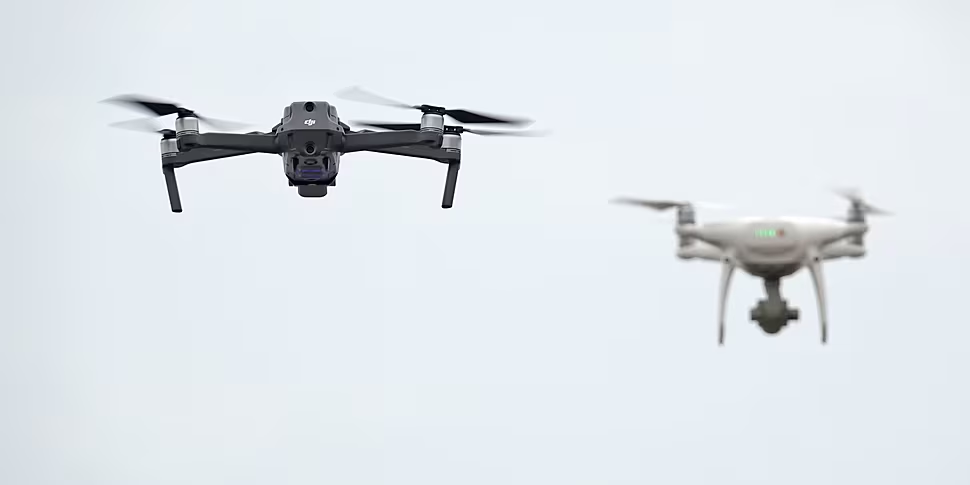
In the days following President Volodymyr Zelenskyy’s visit to Dublin, uncertainty has emerged around reports of several unidentified drones detected off the Irish coast.
Speaking on The Anton Savage Show, former Tánaiste Joan Burton and Kevin Doyle, Head of News at Mediahuis Ireland, discussed what this meant for the future of national security in Ireland.
Initial reports suggested the drones had breached the flight path of Zelenskky’s incoming aircraft.

However, Doyle clarified that this detail appears increasingly unclear:
“I still don’t actually know what went on during the week,” he admitted.
“It’s slightly worrying that we appear to have the Gardaí and defense forces briefing against each other.”
Five drones were detected over the Irish Sea, each seemingly operated individually.
“It's all very bizarre,” Doyle said.
“It might be useful if the Defense Minister came out and told us something about it," he added.
Burton also noted that the presence of multiple unidentified drones “coming down the Irish Sea” in the time of a visiting wartime president should alarm officials.
The change of global warfare
“Warfare is changing very dramatically," said Burton, warning that Ireland may not be prepared.
"We should be keeping up with it.”
Doyle argued that defense investment remains politically unappealing:
“There are very little votes in defense spending in this country.
We’ve never felt under that much threat in the last hundred years.”
The panel agreed that Ireland still lacks a national conversation about defense, particularly in a world where conflict increasingly happens through cyber attacks and drones.
Unlike visible terrorism in the early 2000's, Doyle enphasised that modern threats such as cyber warfare is difficult for the public to visualise.
“This is different,” he explained.
“People can’t wrap their head around cyber attacks.
They can’t wrap their heads around drones.”
Ireland’s neutrality, he argued, can no longer be relied upon.
Burton said Ireland must “upgrade” its defense forces and prioritise public communication about risks.
Written by Annemarie Roberts


