




The Government’s new saving scheme will end up handing money to rich people “who don't really need a tax cut”, an economist has argued.
Tánaiste Simon Harris believes too many Irish people are getting a poor return on their savings, with around €173 billion languishing in deposit accounts.
The Minister for Finance wants to encourage a more American style culture of investment, which will generate higher returns for savers over the medium and long-term.
It is expected that investments will be taxed at a lower rate than the current level of Capital Gains Tax or income tax.
On The Claire Byrne Show, Trinity College Adjunct Professor of Economics John FitzGerald said the beneficiaries of the savings scheme will be disproportionately wealthy people.
“Well, 60% to 80% of the deposits are held by the richest 20% of people,” he explained.
“So, if you're going to give tax relief to people with deposits, it's going to be the people with big deposits who are rich.
“So, it will mean giving tax cuts to people on high incomes and it will be at the cost of society as a whole and those on lower incomes, which seems to me a bad idea.”
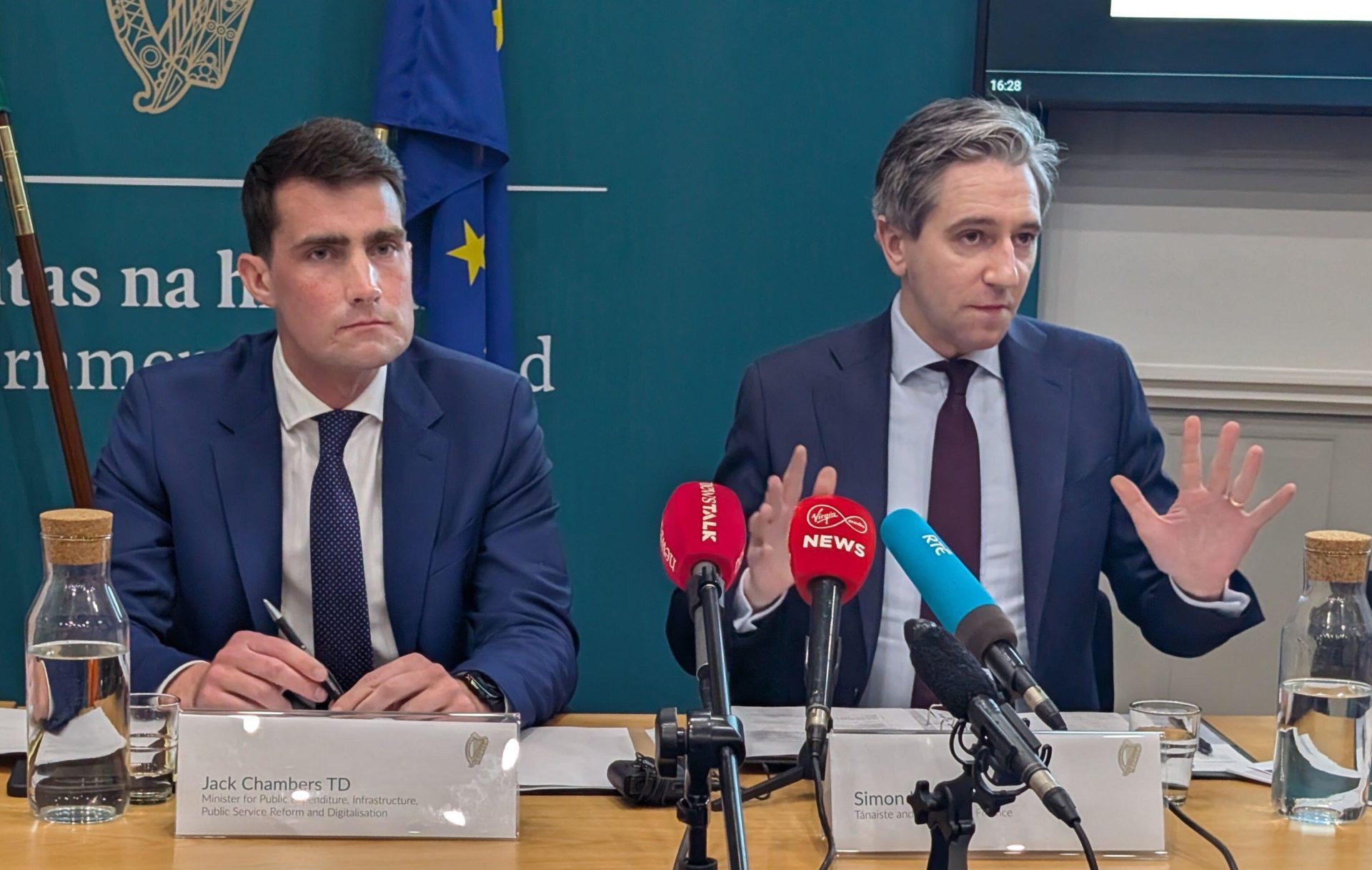 Public Expenditure Minister Jack Chambers and Finance Minister Simon Harris speaking during a press conference at the Department of Finance. Picture by: Alamy.com.
Professor FitzGerald added that he does not “know why he [the Tánaiste] is doing it”, arguing that “the bulk of companies in Ireland are not looking for money”.
“There isn't an issue of business in general needing money,” he said.
“There is at a European level; Irish banks, their problem is that the business community in Ireland is substantially multinationals who don't want their money.”
However, Professor FitzGerald conceded that startups often struggle to get funding in Ireland, with many investors hesitant to give money to a completely new business.
“For example, Stripe and Havoc went to the US for funding,” he said.
“But the funding for startups is risky; there's no way that a sensible person who has money in a deposit and wants to keep the money safe is going to go into funding startups.
“So, I think it's a solution to a non-problem.”
 Counting banknotes. Picture by: Alamy.com.
Given the small number of Irish companies listed on the London and New York Stock exchanges - where most funds will invest their money - Professor FitzGerald added that little of the money will be invested overseas.
“The way Simon Harris's plan would work is that people move money into a fund which is invested in shares, stocks and shares,” he explained.
“But the vast bulk of those stocks and shares will be quoted on the US stock market or possibly on European stock markets - none of it will be in Ireland.
“It will take money which is on deposit in Irish banks and move it into foreign investments in the rest of the world and earn people a bit more, especially those on high incomes.”
Overall, Professor FitzGerald believes the scheme is a waste of money.
“It's giving money to people who are wealthy, who don't really need a tax cut,” he argued.
Main image: A man holding Euro banknotes. Picture by: Alamy.com.


