


Disabled public transport users are sharing their experiences of being challenged by other passengers when they ask for help or a seat.
While there are seats and areas marked for disabled passengers or those who need a seat, time and time again, they're occupied.
Lunchtime Live was joined by a number of people sharing their experiences, with one woman saying she was told by another passenger that if she was that disabled, she shouldn't be working at all.
Jess Ní Mhaoláin has a vision impairment (and uses a white cane) as well as endometriosis and pudendal neuralgia, which causes an issue for her when standing.
Ms Ní Mhaoláin told Andrea Gilligan that she would get the train when she needs to go to work, and there's one that she tries to avoid as it's usually rammed by the time it gets to her stop.
As she boarded the train, she tried to find where the disabled seats were, and found a gentleman sitting there who she asked if he wouldn't mind moving so she could use it.
She continued: "The guy that was closest to me, I just tapped him on the shoulder and I was like, 'Sorry, can I sit down there, please? That's seating for people with disabilities'.
"And he could have been having a bad day, [but] he gave me like two real dirty looks and eventually moved. So then I sat down.
"That's uncomfortable enough. So I sat down and kind of was folding the cane back up and the woman standing in front of him just loudly announced to everyone, 'If she's that disabled, she shouldn't be at work.'
"Like, sure, if we all had that attitude, nobody would be at work. It's highly embarrassing.
"People heard her, but nobody agreed with her. I'd be the first one to kind of say, 'Oh, I'd say something to someone now'.
"But it's actually when you are the person in that situation, you're just humiliated.
"All these other fully sighted people are around me and it's just the discomfort, the humiliation. It does kind of shape your day."
Audrey Torney also joined the show and she explained that she's blind and has a guide dog or uses a cane, and while she acknowledges there are some invisible disabilities, it's very obvious that she is disabled.
She shared: "I have a guide dog, so it's very visible to other people that I am blind. And I'm actually between guide dogs at the moment. My previous dog has just retired so I'm back to using the white cane.
Generally, if I was travelling outside Dublin, I would always book a seat with the disability services. And as Jess said, it will guarantee that you get a seat. There's no drama or no standing around because it can be challenging enough.
"I wouldn't be able to find a seat when I had the dog. I'd have to rely on the guide dog and ask her to find a seat.
"Generally, people are very good and if I do, say, come across somebody who might be a little bit disciplined or challenging, and question why I might want to sit or need to sit down...
"For a start, I don't want to be standing in the aisle with a guide dog anyway.
"If I meet that kind of reluctance with just an explanation as to, 'Look, it's easier for the dog and myself to be in and out of the aisle,' they generally start to see why somebody with a disability, visible or otherwise, may need a seat."
Paddy Smyth, social media personality and advocate, has cerebral palsy and uses crutches full time, and even he sometimes gets comments or people fully ignoring him if he gets on public transport.
He shared: "A lot of this, I think, is just human decency and just to remember that we're all just trying to live a proper life and live the best life we can.
"It's hard for people with disabilities like myself and [Jess and Audrey] to go on public transport and do day to day activities. We just don't need that pressure put on us to ask people for seats.
"It's always happened to me. I don't understand. I'm in the doors or on the bus when there's no seats and people just pretend I'm not there and then I have to ask them [for the seat].
"I know I'm visibly disabled, like with the crutches. Visibly, you can see the crutches."
Peter Gohery, Chair of physical impairment Ireland and Chairperson of Galway Disability Forum added that he has an invisible disability, in that he lost a leg and he needs the extra legroom.
However, as people can't see his prosthetic, he can receive comments and pushback for needing the seat.
He said: "Where I was sitting on the train coming out of Dublin one evening was on the inside, minding my own business with the earphones on and the train was pretty packed.
"This lady came up and I didn't hear her, but she started mouthing off. And there was another person who actually works with the HSE stood up and he said, 'Well, that person has a disability. What are you complaining about?'
"[The woman replied] 'Well, it doesn't look like he has a disability to me.' Now, my disability is I lost a leg [and have a] prosthetic leg.
"I couldn't stand up because I wouldn't be able to balance myself on a crowded train. I'd be bumping into everyone. I'd be afraid I'd fall.
"There's nothing to hold on to and she just kept it up, the whole way down."
Mr Gohery added that they have members who are afraid to use Irish Rail because, down in the countryside, you have to notify them 24 hours in advance if you want to use a wheelchair on a train as some of these smaller stations are no longer manned.
He continued: "They're all gone automated. That's an issue as well and there's no ramp that slides out from the door of the train to the platform."
Everyone shared their stories to bring more awareness to people about the use of designated seats and areas for people with disabilities.
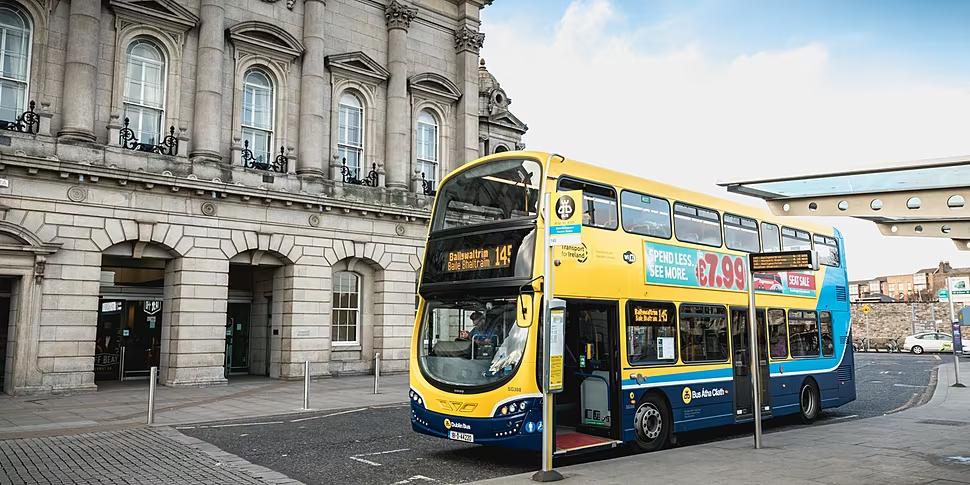
Main image: Dublin Bus pictured outside Heuston station Pic: Alamy stock photo


