



The National Council for Curriculum and Assessment, the NCCA, recently closed its public consultation on proposed changes to the Leaving Cert Maths curriculum.
The revision talks include removing topics like complex numbers entirely from the course.
As a result, mathematical experts have warned that these proposed changes could leave students unprepared or underprepared for third level.
Speaking to The Pat Kenny Show about the proposals, Neil Dobbs, Mathematical Lecturer at UCD and Chairman of Irish Mathematical Trust, said that the NCCA are "trying to rip the heart and soul out of the curriculum".
He explained: "It feels like they're trying to rip the heart and soul out of the curriculum. They're taking away the complex numbers, proof by induction, and geometry.
"These are the aspects of the curriculum which, perhaps, most help students develop their powers of critical thinking, of logic.
"Proof by induction is the only element of logic that's explicitly on the current curriculum and generalisation, which are purported aims of the curriculum.
"They are incredibly important to help prepare students for third level. Trigonometry is mostly gone [too]."
The theory behind the reasons for wanting these changes is that students are too overwhelmed with the workload at Leaving Cert level, but according to Mr Dobbs, it's the teachers as well.
He continued: "[With] the current curriculum, teachers will all say that they struggle to cover it in the time allocated. Part of this is accidental.
"When the current curriculum was introduced, this is a little sign of how ridiculous it is, the first textbook that was produced had a huge influence on the syllabus because the syllabus did not specify things in detail.
"And so there was an overweighting of emphasis on financial mathematics. I don't think anybody really believes that students are incapable of doing complex numbers or other advanced mathematical topics currently on the Leaving Cert syllabus."
Mr Dobbs added that for some of the more complex areas of mathematics, the earlier students are introduced to them, the better they can develop some understanding of them.
The curriculum, as it stands, is reasonably well respected, according to Mr Dobbs, but some people do believe that the assessment is "too wordy".
However, with the proposed changes, he believes any issues will be magnified.
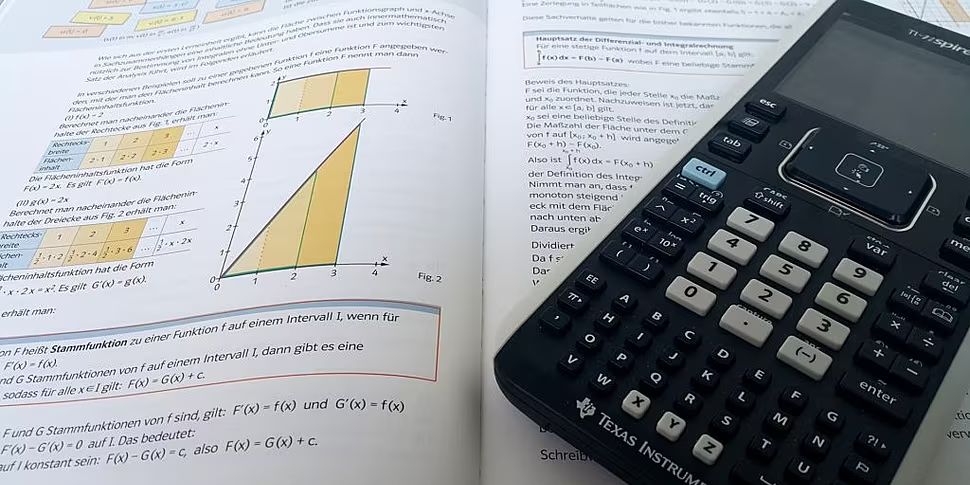
Main image: Teaching maths in school Pic: Jürgen Eick/Pixabay


