


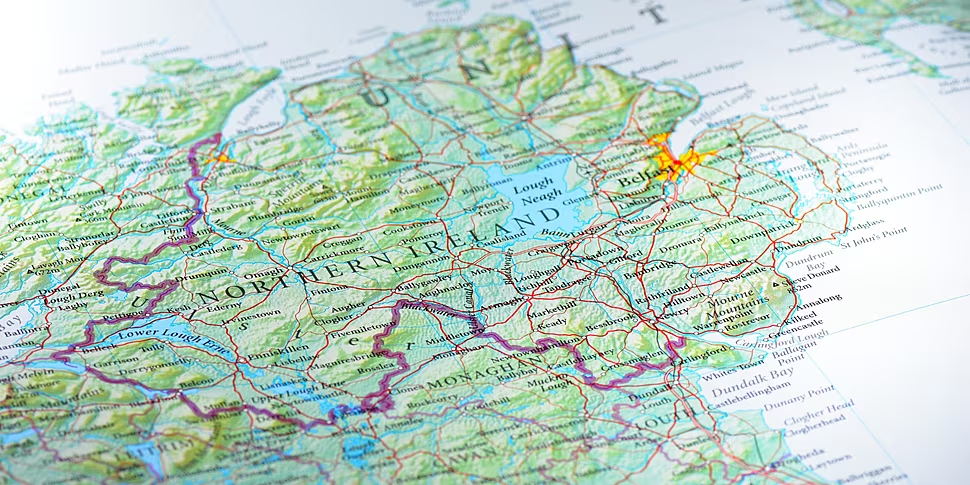
The Irish border between the Republic and Northern Ireland was drawn more than a century ago, and it has never been edited or amended.
The border divided families, farmlands and towns, and to this day, people are trying to understand why it was drawn the way it was.
At the time, the border was drawn where the county lines existed, but while locals and farmers could just walk across those lines, a hard border was a different story.
To explain how it all happened, Dr Cormac Moore, historian, author and founder of HistoryLink joined the The Pat Kenny Show, and shared the thought process behind it.
He said: "So during the third Home Rule crisis, there was talk that something had to be done about Ulster to exclude parts of it or all of it from a Home Rule settlement.
"But that had actually developed from 1919, where the British government decided, 'Why don't we create two parliaments instead of being excluded and being wholly within Westminster?'
"It was going to be two polities, Northern Ireland and Southern Ireland, and the British government's original plan was that all nine counties of Ulster would be in Northern Ireland and the remaining 23 counties would be in Southern Ireland.
"But it was also Unionists who railed against that, because that would have meant 55% Protestants, 45% Catholics. It wouldn't have been a very secure majority.
"They felt it would be outbred by Catholics very soon afterwards [as Catholics had bigger families historically]. So they insisted upon six counties, the six historical counties of Ulster, Derry, Down, Armagh, Antrim, [Fermanagh] and Tyrone."
The outline of the counties was derived in the 17th century under King James, and while that caused farms and towns to be multi-county, it didn't impact the daily lives of the people.
The first few years of the partition also had little impact, it was more of an administrative burden according to Dr Moore, but when the customs posts were erected, that's when things changed.
Journeys that used to only take a few minutes now took much longer and only certain roads were permitted as crossings.
Because of how the border was drawn, it made it difficult to man, with Margaret Thatcher even saying she wanted to straighten it out while she was prime minister.
There was a boundary commission established when the plans for Ireland to be split in two were being made, which were triggered when Northern Ireland didn't join the free state on the treaty.
Dr Moore continued: "That triggered a boundary commission. It didn't convene until late 1924, because of civil war in the south, the north, the north's refusal to recognise the boundary commission and a lot of political turmoil in Britain.
"Once it met, though, it soon dawned on a lot of people that it actually was only going to suggest cosmetic changes to the border.
"And the idea that, for example, Newry would become part of the free state. That was not on. That Derry would become part of the free state. That was not on.
"But the free state commissioner, a chairperson, Richard Feetham, decided that there wasn't enough justification to move Newry [even though it was 75% Catholic].
"So only small parts of Armagh, Crossman Glen would have been moved south, parts of Tyrone from Manor. But very importantly for the free state government, they were going to lose rich parts of East Donegal, rich parts of North Monaghan.
"And when this was leaked by a newspaper morning post on November 25, WT Cosgrave rushed over to London to have the boundary commission report shelved.
"And that's why it was shelved. And that's why we have the border as it is today."
Main image: A map showing the Irish border. Pic: Selwyn / Alamy Stock Photo


