


It is “very problematic” to say that a mass shooting like the one on Bondi Beach could not happen in Ireland, a leading psychologist has said.
16 people were killed and many more injured when gunmen opened fire on a group of Jewish people celebrating Hanukkah - the Festival of Lights.
While gun massacres may be common in the United States, such tragedies are very rare in Australia, which University of Limerick Professor Orla Muldoon praised as having “very good” gun control laws.
Ireland also has strict gun control years but Professor Muldoon cautioned that the existence of laws cannot prevent all crime.
“There are seven guns per 100 people in Ireland,” she told Newstalk Daily.
“So, the idea that we aren’t an armed country probably isn’t quite correct.
“But we don’t have semiautomatic weapons.
“We certainly do have frequent rural firearm incidents… but there are quite a lot of guns in Ireland.”
Professor Muldoon added that there are also an unknown number of illegally held firearms.
It all means that the possibility of a mass shooting cannot be ruled out.
“The idea that this couldn’t happen in Ireland is very problematic because there are so many,” she said.
“Availiability of a gun is the single biggest predictor of whether or not this is likely to happen.
“Then, there is the copycat element and there is quite good evidence from the States that there is a social contagion effect.
“There’s clustering around these types of incidents, in part because there tends to be a lot of publicity and even valorisation of the people who perpetrate the crimes.”
View this post on Instagram
The attack on Jewish worshippers was quickly denounced as an "act of pure evil, an act of terror, an act of antisemitism" by Australian Prime Minister Anthony Albanese.
Professor Muldoon warned there is nothing to suggest that Irish people are uniquely immune to the dark forces that led to the massacre.
“There is no question that what has happened in Australia is part of a wider problem to do with the Middle East,” she said.
“None of the issues that took those shooters out on that day started the day before.
“Irish people should be very aware of how it is that people can become radicalised and over-identified with political causes, go out, kill and injure others.”
Rising anti-semitism
In the aftermath of the massacre, Ireland’s Chief Rabbi Yoni Wieder warned that the “utterly sickening” attack did not come as a “complete surprise” given rising levels of antisemitism across the world.
“There's been a rise in hatred, a sharp rise in hatred against Jewish people - both online and in real life, anti-Semitic incidents,” he said.
“And it's been rapid and it's deeply disturbing; there's been a one sided inflammatory anti-Israel rhetoric that has become normal across much of Irish media and politics.
“And like it or not, that atmosphere gives confidence to those who seek to intimidate and target Jewish communities in Ireland - even when politicians and commentators never intended it in that way.”
Following the Sydney attack, Garda Commissioner Justin Kelly contacted Rabbi Wieder to discuss how security at Jewish communal events in Ireland could be enhanced.
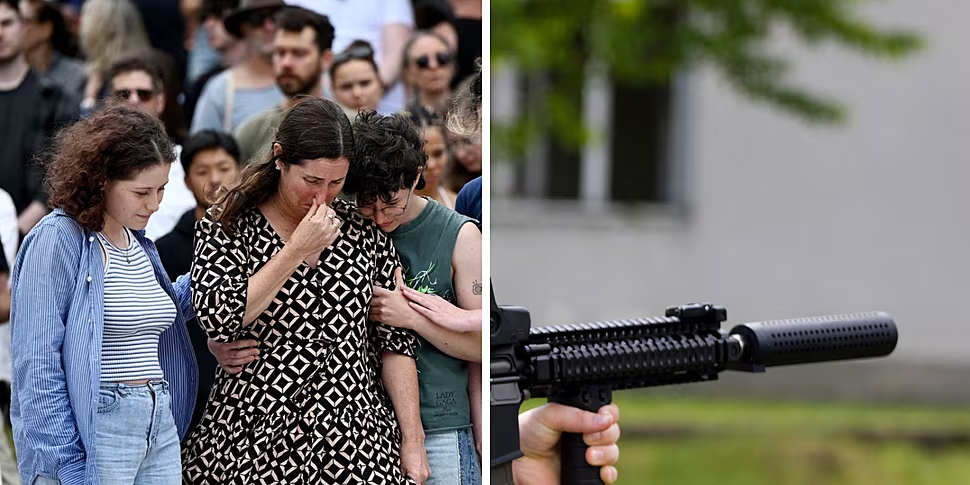
Main image: Split of mourners in Sydney and a rifle. Pictures by: Alamy.com.


