



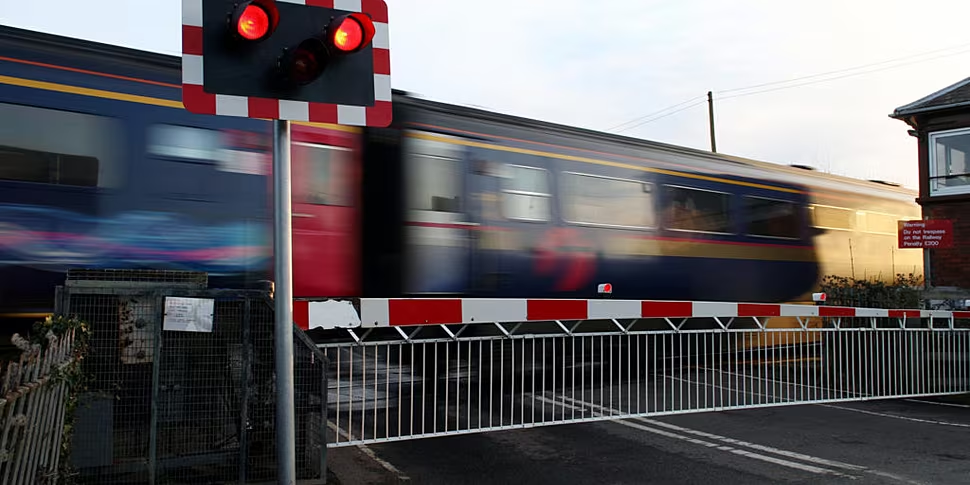
After two incidents at level crossings recently, questions are being posed as to how junctions between Irish rail and road users can be made safer.
While there are many safety features already in place at level crossings across Ireland, there is still a risk factor when using them.
From automated crossings to ones operated by the driver or farmer themselves, you always need to be cautious when approaching a rail junction.
After two incidents in as many days recently, with one causing the death of a 12-year-old boy, the safety of level crossings is being called into question.
The Pat Kenny Show spoke to Mark Gleeson, a spokesperson with Rail Users Ireland, explained that in many cases, an automated level crossing isn't possible, due to location and also cost.
But, he also hypothesised that building a bridge could solve a lot of the potential risk factors with human-operated crossings, and could even improve the rail network over all.
He explained: "We have the automated level crossings in Dublin, we have them elsewhere across the country, and they're very reliable and very safe, but they're very expensive.
"Irish Rail has rolled out at almost 70 locations now a warning system at these user work level crossings where you get a red light or an orange light, red light is on, do not cross.
"If an orange light is on, follow the instructions, cross with care. And if any point in time the red light comes on, you know, clear the crossing. So they've installed that in almost 70 and there are more locations to go.
"And that's a great help and that's also significantly improved discipline at crossings where people are not leaving the gates open anymore or we're not having what they call near-miss events where people almost zip across in front of an approaching train."
However, as you can imagine, all of this technology comes with a cost, and in some cases, it would be cheaper to build a bridge.
Mr Gleeson continued: "In many cases, it would be cheaper to put a bridge in if you can get agreement to the local landowners.
"Obviously, there's an engineering challenge for Irish Rail and the local authorities to work on, but the key thing here is you can build a bridge, you eliminate the safety risk, you may be able to let the trains go faster."
This would mean that trains are breaking and accelerating as much, which reduces cost, those looking to cross have less wait time, passengers get to their destinations quicker and would encourage more people to use the train.
Not to mention, by closing some of the crossings, safety risks would be improved.
Of course, there's also the risks of trucks crashing into bridges, but in many cases, this is attributed to sat-nav technology not informing the user of the height clearance of the bridge ahead of time.
Mr Gleeson added: "This is an ongoing issue, and I think it came up also in terms of a previous level crossing accident, that 'the sat-nav sent me that way and I didn't realise what was in front of me'.
"So there has been some correspondence between the Rail Access Investigation team and Google to say, can you enable features in your navigation to say this bridge is low or you're approaching a user work level crossing? They have those features in the US, so why don't we have them here?"
Main image: Irish rail level crossing


