


Sinn Féin is not saying that the “fairly ambiguous criteria” for a border poll has been met, John Finucane has said.
Yesterday, Andy Burnham visited Belfast for the first time as British Prime Minister and made clear that he had no plans to authorise a referendum on Irish unity.
Speaking to the BBC, the Mancunian said a border poll is “off the table” and said he wants to “fix the things right in front of us in the here and now”.
He also referenced recent referendums on Britain’s membership of the EU and Scottish independence, which he said underlined that the "risks that come from those situations take a long time to heal".
On Newstalk Breakfast, MP John Finucane said Sinn Féin had met with Mr Burnham during his visit, where they discussed the many “challenges” facing Northern Ireland.
The party also made clear to the Prime Minister that Sinn Féin is committed to a referendum on Irish unity at some point in the future.
“We were very clear with the Prime Minister [that] the right of the people of Ireland to determine our own future is provided for in the Good Friday Agreement,” he explained.
“It's an international agreement and that democratic right cannot simply be dismissed or taken off the table by any British Prime Minister.
“We put that position to him directly, unequivocally, and he accepted that.
“As a matter of fact, he reiterated his commitment to the Good Friday Agreement and confirmed his support for the agreement in all of its parts.”
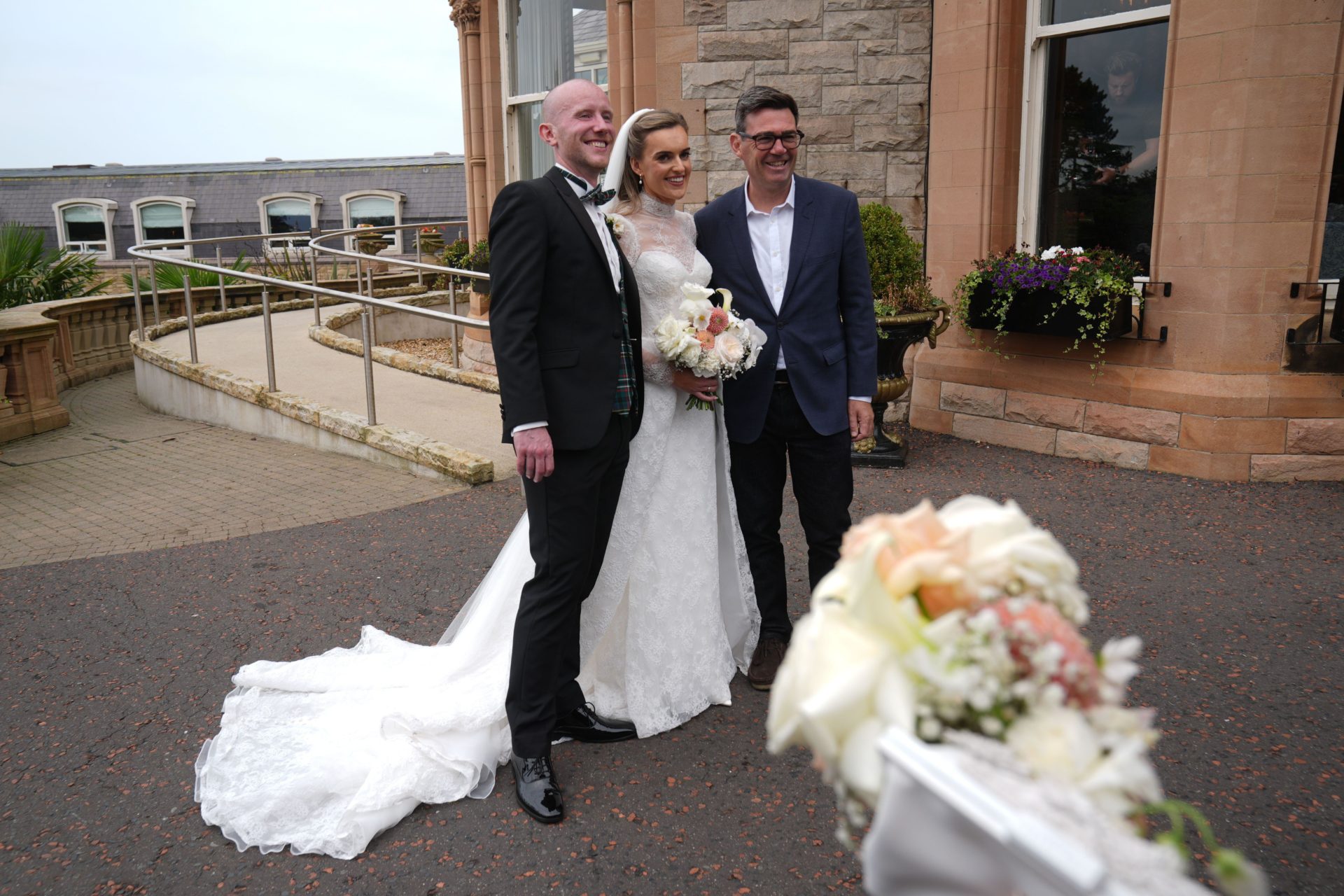 Andy Burnham meets bride and groom Conor, from Belfast and Kira, from Liverpool, Rosato, as he arrives at the Culloden Hotel, Belfast, during his first visit to Northern Ireland as Prime Minister. Picture by: Alamy.com.
The Good Friday Agreement established the principle that a border poll would be organised by the Secretary of State for Northern Ireland if it “appears likely to him that a majority of those voting would express a wish that Northern Ireland should cease to be part of the United Kingdom and form part of a united Ireland.”
In a poll in May, the Institute of Irish Studies found that 50% would vote against a united Ireland if there was a referendum tomorrow, while 36% would vote yes, with 14% undecided.
“We certainly weren't saying that the fairly ambiguous criteria contained within the Good Friday Agreement has been met,” Mr Finucane said.
“But what we were saying to him loud and clear is that the Good Friday Agreement was voted for overwhelmingly by people on this island and you don't get to have an à la carte approach to what parts of that agreement you particularly like or dislike.”
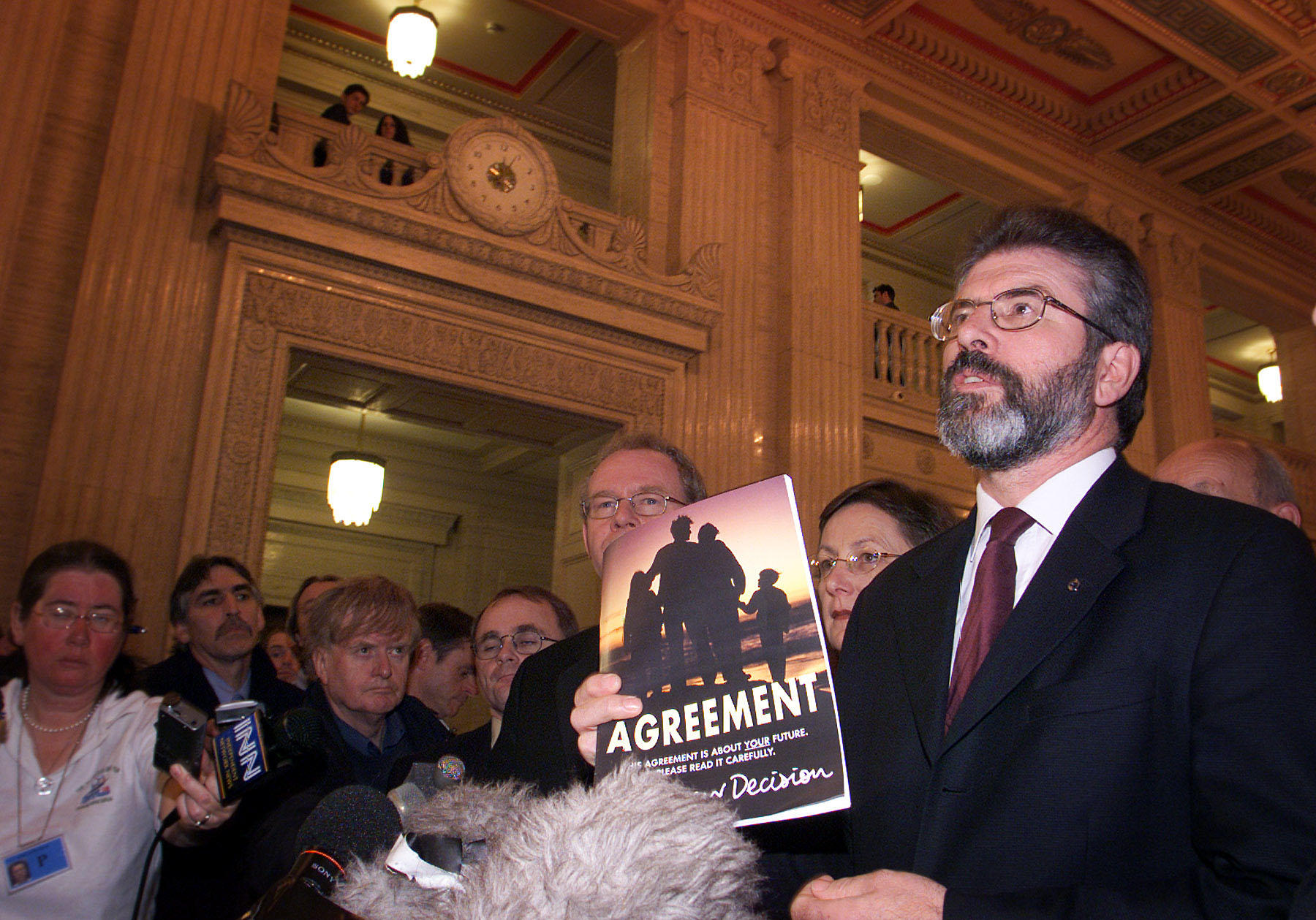 Gerry Adams holds a copy of the Good Friday Agreement. Picture by: Alamy.com.
Also on the programme, DUP MP Gregory Campbell he was pleased to hear Mr Burnham promise to focus on that will “unite people, not divide them”.
“There's nothing that would be more divisive than what Sinn Féin and others want to do, which is try and drive a stake through people trying to come together,” he argued.
“Rather than going back to some sort of divisive, toxic debate that would just fracture communities and set us back years.”
The East Derry MP continued that it is “not odd” that Mr Burnham would rule out such a poll as “there's no prospect of that criteria being met”.
“There's a whole series of agreements,” he said.
“The underlying aspect of all these agreements, whether we were in favour of them or against them, the underlying aspect both in the UK Government's mind and in the Government of the Republic's mind was how do we devise a system that can try and bring people together.
“So, that they can operate a political system in Northern Ireland where we have completely diverse opinions.”
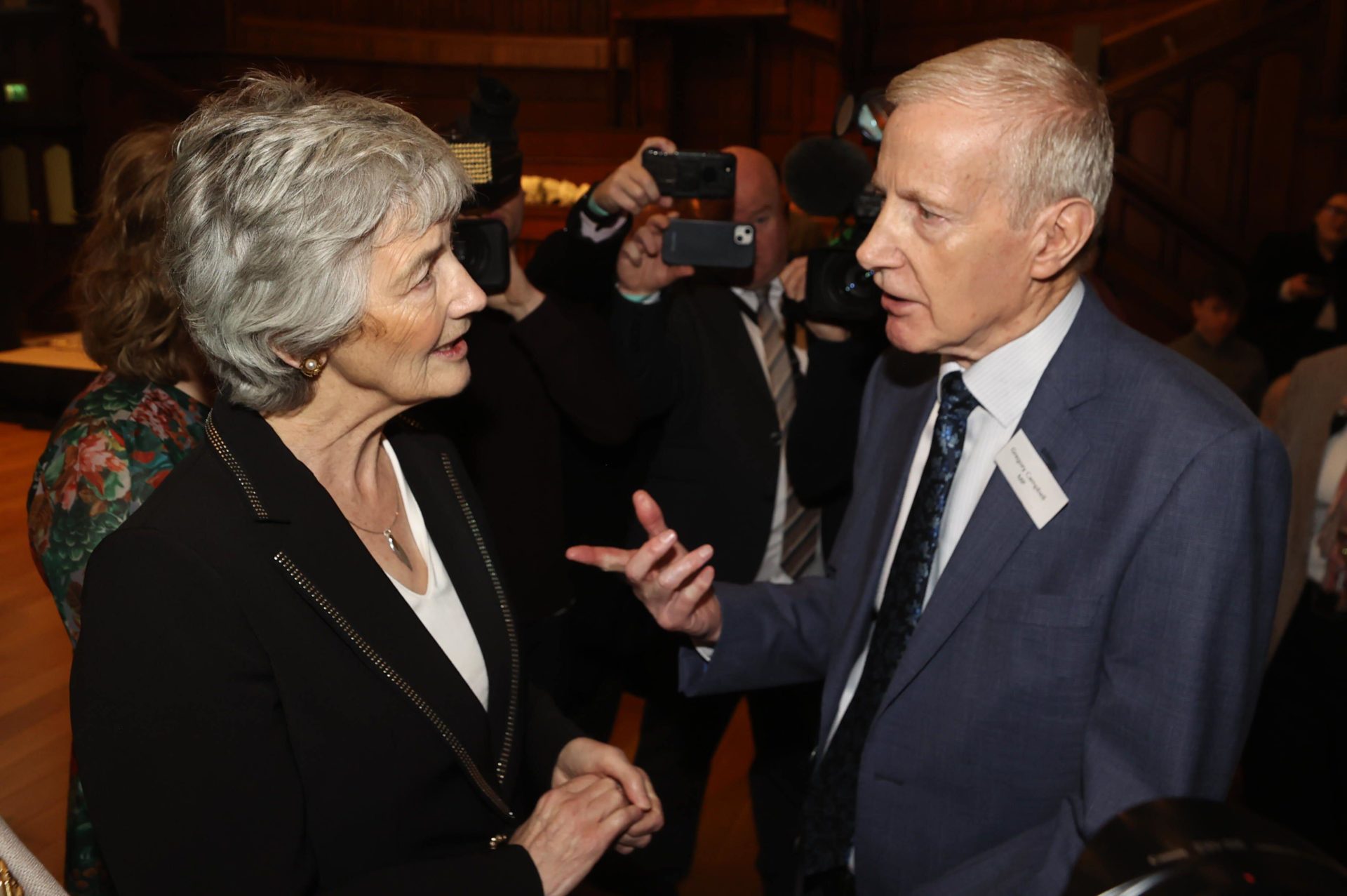 President of Ireland Catherine Connolly with Democratic Unionist Party MP for East Derry Gregory Campbell. Picture by: Alamy.com.
The last time a border poll was held in 1973, 99% of people voted for Northern Ireland to remain a part of the United Kingdom, while 1% cast a vote for the six counties to join the Republic of Ireland.
Turnout was 59%, with the vast majority of nationalists boycotting the poll, arguing the referendum should have included voters in the 26 counties.
Before the poll, Prime Minister Ted Heath has promised there would be “a system of regular plebiscites in Northern Ireland about the Border”, but no further polls were held due to the controversy surrounding the first.
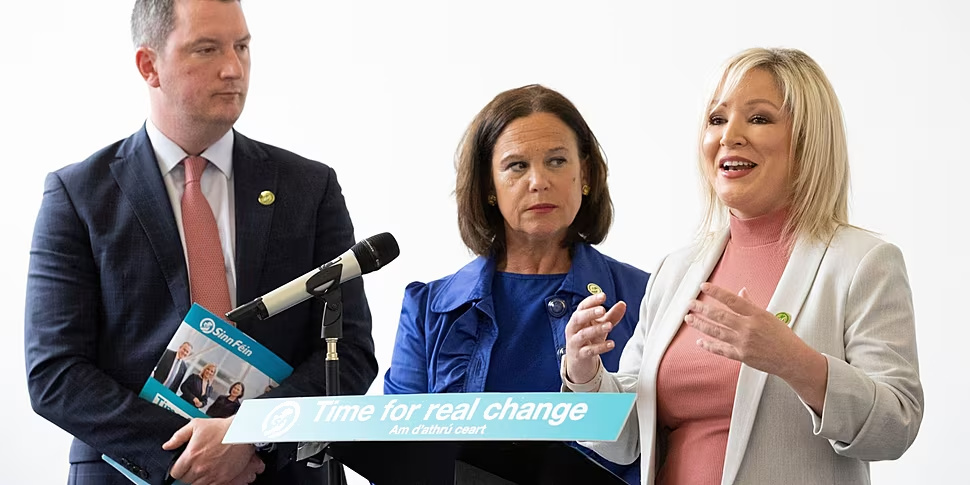
Main image: John Finucane, Mary Lou McDonald, and Michelle O'Neill. Picture by: Alamy.com.


