



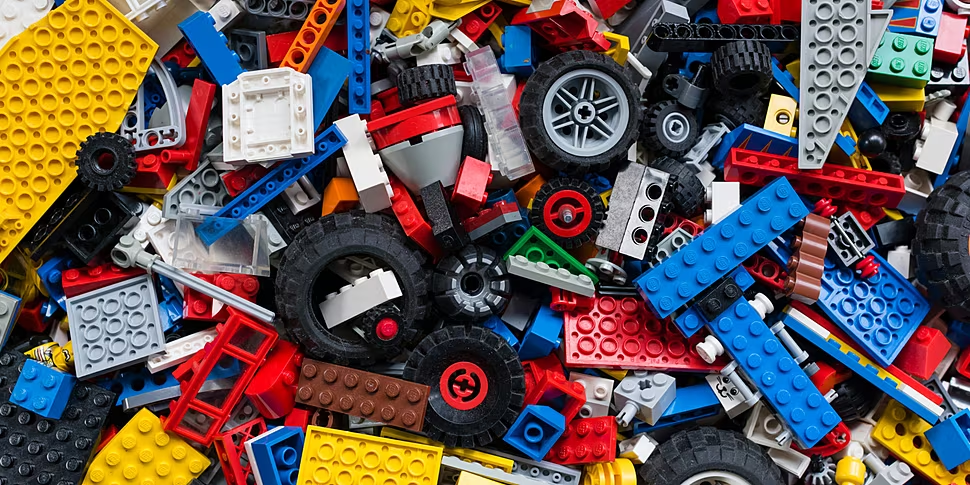
A new Guinness World Record has been etched into the annals of history as a group in the UK sent a Lego figure into space.
For the first time, a piece of Lego has gone where no building block has ever gone before when sending mundane items into space.
A Lego figurine has gone into space, garnering a Guinness World Record in the process.
The company Send Into Space designs craft purposed for the objectives of clients with up to 95% of the objective of such envoy being advertisement.
At times, it may be to activate some kind of theatrical feat for the purposes of showing off the functionality of a device for example.
Dr Chris Rose, head of projects at Send Into Space told Moncrieff there are “a tremendous amount of variables that go with sending objects into space.”
“We have to spend a lot of time thinking about pretty mundane items, but how they will react in this very unusual environment.
“In our line of work we do get a lot of confounding variables we need to consider.
“For a LEGO figurine, temperature is really important because while it may not compromise the bricks themselves, if they were encapsulated - they don’t respond well to being in the vacuum of space.”
Sending 'mundane' items into space
Mr Rose explained that under such conditions, elements could explode or fail but that given the durability of LEGO the likelihood of anything going wrong was less likely.
“If we were to have some sort of structural reinforcement here to make sure that no components come off , we need to make sure that that doesn't become embrittled or fail due to the very, very cold temperatures of space”, he said on Moncrieff Friday.
“We need to make sure that we restrain everything in a way that makes sure this is safe and reliable.
“We also don't want to overwhelm the feature setup. We want to show that floating in space in all its glory.”
He explained that all that was needed to ensure the LEGO could go in space with maximum structural integrity was making sure it was affixed to its base with some support at the back.
 A box full of mixed colourful Lego bricks
“We need to take care of the very vulnerable parts of the structure”, he said.
The objects are brought into space thanks to a balloon that expands with altitude and is then either deflated remotely or self-deflates.
“What we do have is what we want to do is to get as high as possible.
“We want to allow it to run its course naturally according to simulations that we find favorable. We don't want this to land in any populated or off the coast into the sea
“Override technologies can bring this down to earth much earlier and under our control.”
He explained that when the object lands, it is received by the recovery teams that can work off GPS and bias a return journey should the need arise.
Air traffic control permissions are necessary to undertake what Send Into Space does.
“From past experience, we would expect sort of to be recovering this 150 to 200 kilometers from wherever we launched from.
“Unless we're doing this from our Swedish launch site, where we can see much more prolonged flight paths.”
Main Image: Mixed colourful Lego bricks.


