



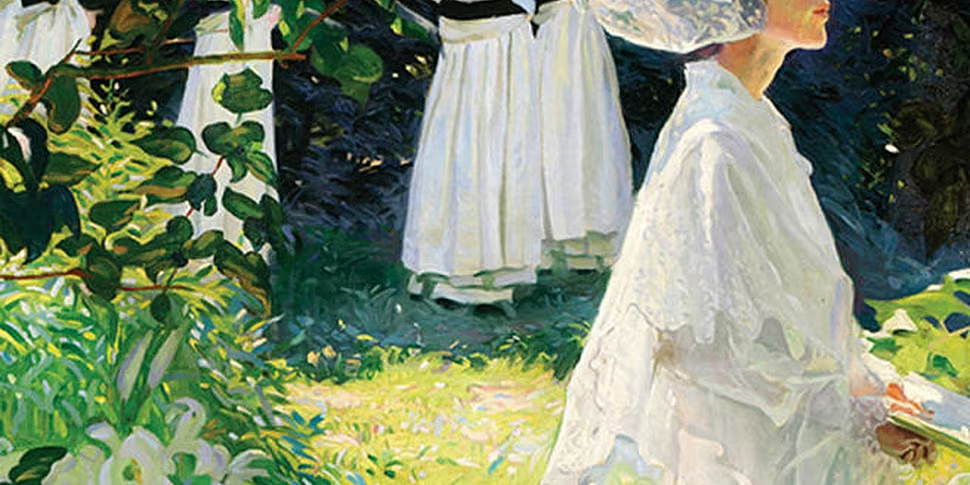
The National Gallery of Ireland was founded in 1854. In its 150 year long history the gallery has housed some of the greatest works of art from Ireland and the wider world. It has become a national institution and one of the cornerstones of Ireland’s cultural and artistic identity. In celebration of its 150 years enriching Irish life the National Gallery has published ‘Lines of Vision; Irish Writers at the National Gallery’.
This book features new poems, stories, and essay from 56 Irish writers inspired by works of art from the gallery’s collection. On this episode of ‘Talking Books’ Susan talks with four of these authors about the pieces they chose to write about and how art can inspire writing. Join Susan as she talks with Macdara Woods, Enda Wyley, Evelyn Conlon, and Eoin McNamee about ‘Lines of Vision’.
 'Members of the Sheridan Family' by Edwin Henry Landseer, 1847. Photo © National Gallery of Ireland
Poet, translator, and editor Macdara Woods chose to write about Edwin Henry Landseer’s portrait of Charles Kinnaird Sheridan with his sister-in-law, Marcia Maria Sheridan, and her son. This haunting image shows the young diplomat confined to an invalid’s chair by the shadow of tuberculoses; seemingly lost in contemplation and oblivious of Marcia and the child. The fact that this painting was finished only after Charles’ death only adds to the works melancholy.
 'A Lady Holding a Doll’s Rattle' by Sarah Henrietta Purser, 1885. Photo © National Gallery of Ireland
 ‘An Emigrant Ship, Dublin Bay, Sunset’ by Edwin Hayes, 1853
Novelist, short story writer, and essayist Evelyn Conlon was the only author to pick two pieces of art to talk about. ‘A Lady Holding a Doll’s Rattle’ is an example of Sarah Purser’s mastery of portrait painting. While this work captures the intimacy of art and the style of 19th century Parisian high society, Edwin Hayes’ painting is of an altogether different world. The image of an emigration ship at anchor in the mouth of the Liffey in the wake of the Great Famine this painting captures so much of Ireland’s history.
 'Angels' (detail) by Harry Clarke, 1924. Photo © National Gallery of Ireland
Enda Wyley, children’s author and poet, chose a painting by the great Irish artist Harry Clarke as the inspiration for her piece. Known mainly for his amazing work with stained glass Clarke nevertheless excelled in most mediums. This painting of an angel, one of six made for St Mary’s Church in Haddington Road, is one example of his wide variety of skill. Yet this work, and its cohorts, was almost lost except for the luck of a passerby.
 'Magdalene' by Alice Maher, 1998. © Alice Maher, IVARO 2015. Photo © National Gallery of Ireland
Eoin McNamee was the only author who chose to write a piece inspired by a living artist. Though a simple portrait of a woman’s long locks Alice Maher’s ‘Magdalene’ manages to capture so much of women’s history and the essence of female identity. Is this the image of a woman from behind, her hair cascading in full feminine beauty? Or are we seeing the subject head-on, her face hidden behind a curtain of hair? The sordid history of the Magdalene laundries, however, will always leave this painting with a dark edge.
 Clifton beach Karachi, October 2005
Rounding off the show Susan talks with Kamila Shamsie about growing up in Pakistan, becoming a British citizen, and her life as a writer. Born in 1973 to an accomplished family of writers and journalists Kamila became famous in 1998 with the publication of her first novel, ‘In the City by the Sea’. Drawing on the turbulent political history of her native Pakistan this debut novel tells the story of a boy on the cusp of manhood in a confusing and dangerous world.
Kamila built on the success of this first work with her subsequent novels and today stands as one of Pakistan’s most popular and successful writers. Though she moved to London in 2007, and has since become a British citizen, Kamila continues to draw on the history, culture, and politics of Pakistan for her writings.
Join Susan this as she talks with Kamila about her novels, the politics of Pakistan, and life in her hometown of Karachi. What was life like growing up in ‘The Gateway to Pakistan’? Why are her novels so charged with politics? Why did she choose to move to London? And what has life as a writer been like for her?


