



It's been confirmed that the next public sector shutdown will take place on November 12.
Ireland's public sector is going on strike again after the meeting with the trade unions failed to resolve their concerns.
The shutdown is scheduled to take place on November 12, a Thursday, after it was initially suggested for Wednesday November 11.
Speaking on the announcement, Newstalk's Ella Anderson joined Lunchtime Live to explain what this 24-hour stoppage entails.
Does this strike involve the same public services as the previous strike?
So far, the plan is the same public service groups will be involved in the strike, but according to Ms Anderson, the only difference will be a "little bit in derogation".
She explained: "We might see a few more sectors, a few more parts of the unions getting derogations. But other than that, it should be about the same.
"So we're talking easily, you're in the 100,000 [people in the] 24-hour strike. And they're also looking at escalating the current work to rule and also considering striking further after November 12, but no date has been given yet."
Why are they striking again?
It seems that after the meetings today, the unions aren't happy with the progress that has been made in the pay deal discussions to date.
Ms Anderson elaborated: "Last week they came out and said that they'd reached a 'pretty significant impasse', in their own words, with the talks there.
"Today they said that the government has failed to put an offer on the table that they're happy with and that they feel represents the amount of work that public sector workers are putting in and reflects inflation as well.
"They say it's just not fair and it doesn't reflect the cost of living crisis."
Speaking on Newstalk Breakfast, Linda Kelly, general secretary of the ASTI, shared that the offer made by the government that the unions turned down was 6.75% over three years, and when asked what figure they are looking for, Ms Kelly simply responded "more".
She continued: "[6.75%] is paltry. It's simply not good enough.
"We've been very clear right throughout this that government need to address the inflation cost this year.
"What they offered doesn't do that and that they need to look at making up the gap in inflation that has emerged over the last couple of years and their offer doesn't do that."
Will there be rallies held in this strike?
According to the strike announcement, there will be rallies being held all over the country, including the capital.
The unions will be bringing the public service workers together in Dublin city that will coincide with the strike and there will be smaller regional rallies across the country.
These rallies have now been confirmed, with eight locations selected for a main rally and other satellite rallies around the country.
According to poilitical correspondant for the Irish Examiner, Louise Burns, the unions are taking a slightly different approach this time around, with the rallies taking place instead of pickets.
She told The Hard Shoulder: "This is something that the unions had indicated that there would be a big event in Dublin and then, I guess, satellite rallies across the country.
"So what we know now is that the unions are saying that rallies will be held at eight locations across the country.
"So obviously, there'll be one in Dublin, then also Waterford City, Cork City, Limerick City, Galway City, Tullamore in County Offaly, Sligo Town and Letterkenny in County Donegal."
Ms Burns added that this is all under the assumption that the talks between the government and unions remain at the impasse they have been in, but officials have been in and out of meetings the last few days.
She continued: "Whether or not these rallies will go ahead, whether there'll be some kind of deal struck over the weekend, I guess, remains to be seen.
"But the unions are preparing for the rallies taking place on the day of the strike, which will see up to 300,000 public sector workers back out again."
Was the decision to have the strike on November 12 planned to coincide with the EU presidency events?
Kevin Callinan, the chair of ICTU public services committee, reportedly said that the decision wasn't necessarily intentional that they moved it to the Thursday where there's a big EU Presidency event.
They said it was "logistical reasons" to not have it on a Wednesday again and it wasn't necessarily to try and affect the EU meeting there.
When asked about what these logistical reasons were, Ms Anderson said: "He kept it pretty vague. He says that they just couldn't have it on a Wednesday again for quote-unquote 'various reasons'."
He has since shared during a chat with The Claire Byrne Show that the public sector shutdown date decision was actually due to a number of the affiliate unions highlighting how having the strike on a Wednesday again would impact their sectors.
He explained: "What happened was we had originally decided it was going to be Wednesday of next week [November 11] and a number of the affiliate unions, particularly in the education sector, pointed out that another Wednesday had particular impacts for job shares and for school activities.
"And for that reason, the idea of a change of date came on the table. I'm not going to pretend that people aren't angry. I want to deliver a message to the government. We will do that.
"Public servants are responsible people. We will do that in a peaceful way. But we want to make sure that the government understand."
The event in question sees Ireland host the ninth meeting of the European Political Community (EPC) in Dublin.
The meeting brings together European Heads of State or Government, together with leaders of key European and international institutions, for informal political and strategic discussions.
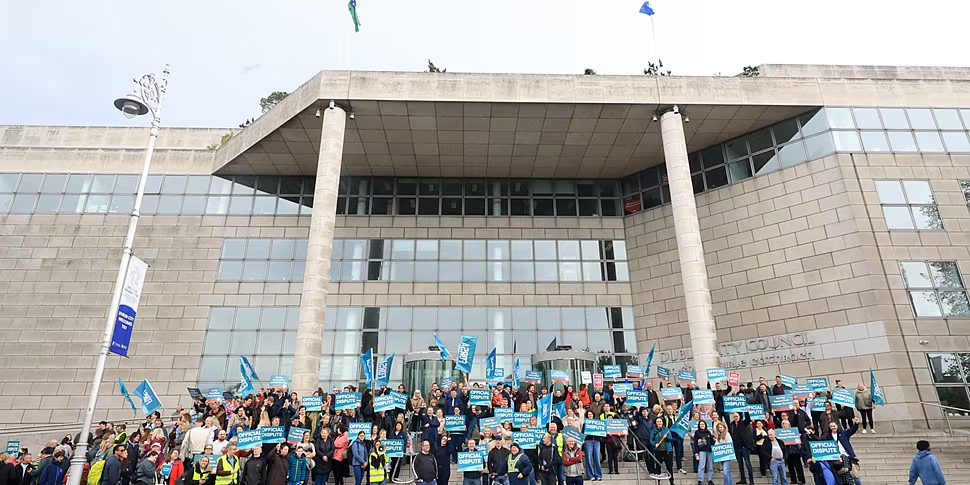
Main image: Members from the FORSA trade unions outside the Council Offices on Wood Quay in Dublin during the first strike. Pic: Leah Farrell/© RollingNews.ie


