




If the war in Iran continues then the “worst case scenario” could see fuel prices double, analysts have warned.
Roughly one fifth of the world’s oil and gas supplies pass through the Strait of Hormuz and the conflict between the US, Israel and Iran has caused chaos in international energy markets.
While the United States and Iran have indicated a willingness to resume peace talks, no date has yet been set.
The IMF has warned that the conflict could tip the global economy into recession, while European Commissioner for Energy Dan Jorgensen has said that “even the best-case scenario is bad”.
On The Claire Byrne Show, UCC lecturer Dr Oliver Browne said the doubling of fuel costs is the “worst case scenario”.
“Bank of America thinks we have two scenarios,” he explained.
“If the trade deal does go through, talks continue and the ceasefire extends, we can see oil come down to about $77, $78 a barrel.
“If the war continues and we don't see any progress escalation even by mid-May, then oil continues at the price it's currently at for the end of the year.
“If it continues beyond mid-May, we start to see those structural supply issues come in and we start to see oil spike.
“Some analysts think $150, something $200, something $250.”
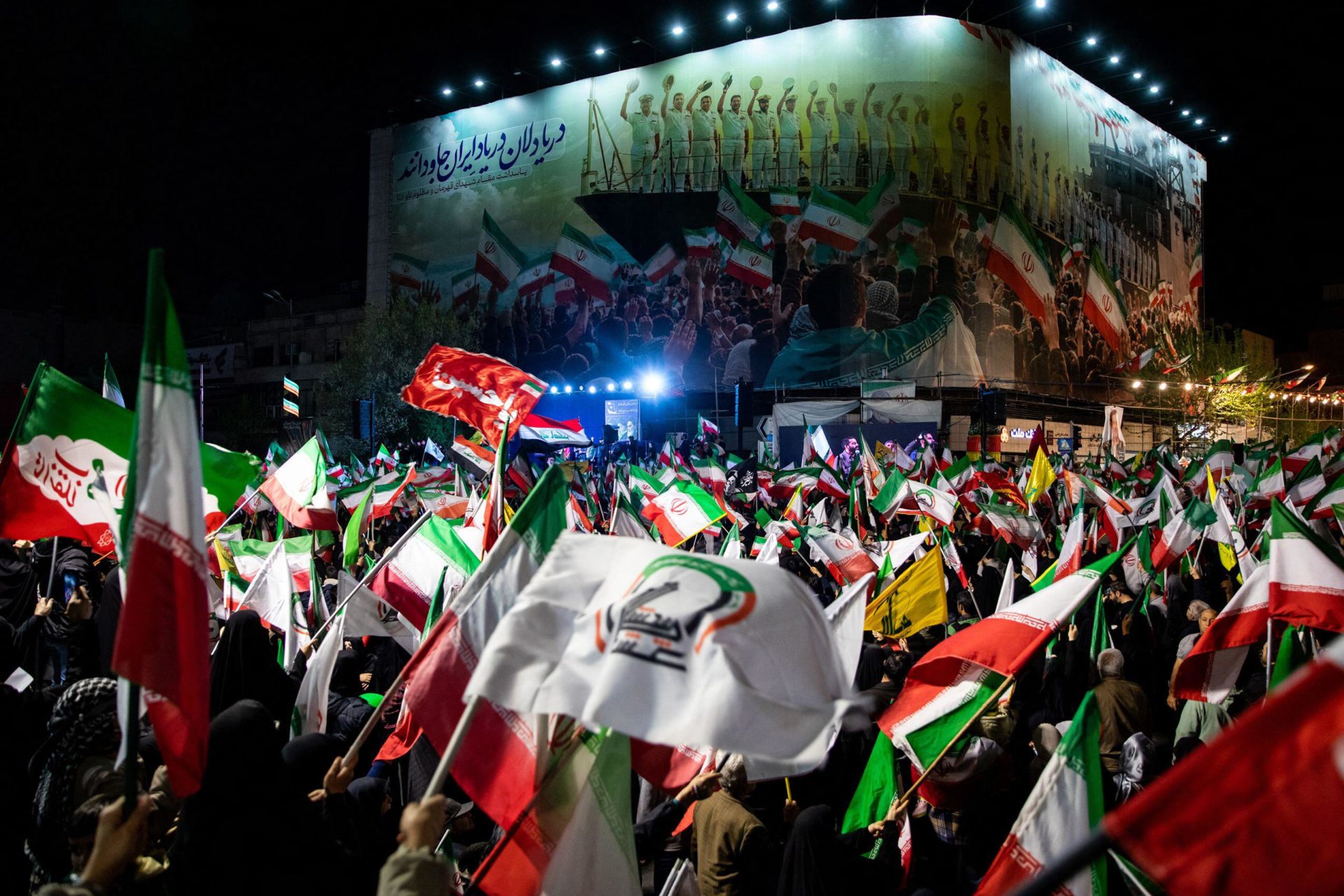 A pro-Government rally in Iran. Picture by: Iranian Supreme Leader's Office.
 Such a shock would prove even more severe than the one after the west imposed sanctions on the Russian economy in the wake of its invasion of Ukraine.
While Russia supplies about 10% of the world’s gas supplies, around a quarter of the world’s oil and gas passes through the Strait of Hormuz.
It means the war in Iran could prove far more damaging economically.
“It's the ships that are currently in transit that would be arriving, the ability to replace our stocks, everything kind of coming together and just causing supply chain issues that cannot be resolved in the short to medium-term,” Dr Browne added.
“That would lead to an incredible supply shock beyond what we've experienced at the moment that would cause it to spike.”
In theory, without further Government intervention, the costs would be passed onto motorists and the price of fuel could even double at the pump.
In practice, the Government would likely intervene, as it has done twice since the conflict began. However, it would prove ruinously expensive.
Main image: A motorist filling up their car with fuel. Picture by: Colin Keegan, Collins Dublin.


