




Emmett Oliver discussed climate change, weather patterns and infrastructure that might reduce the damage in the future.
EU Climate Pact Ambassador Liam J Coyle and Assistant Professor in Civil Structural & Environmental Engineering in Trinity College Dublin called Dr Aimee Byrne joined Newstalk Saturday host Emmett Oliver to discuss climate change, weather patterns and infrastructure that might offer a better fighting chance of offsetting some of the damage in future years.
Mr Coyle told Newstalk that climate change is changing how countries respond to meteorological events in Ireland and across the world by increasing the intensity and frequency of weather Ireland experiences.
“Ireland has always had storms, that’s not new but what is new is how they arrive, how intense they are and just how much disruption they cause,” he said.
“Warmer air holds more moisture which leads to heavier rainfall in shorter and longer bursts. Warmer seas add energy to the Atlantic systems which results in stronger storms that are more frequent with less time to recover in between.”
He noted a shift in public attitudes in relation to bad weather due to its continued effects.
“It means flooded roads, repeated power outages, flooded homes as we’ve seen in the rural and coastal communities, disrupted travel, pressure on insurance, premiums…”, he told Newstalk Saturday’s Emmett Oliver.
He added that these strains have moved the climate conversation away from the abstract into everyday challenges and revealed a mismatch between our weather and infrastructure.
“Storms like Chandra act as stress tests for infrastructure at the reveal where systems come under strain, not because they were badly built in the first place, but because they were built for a different climate.
“The important point here is nothing has suddenly failed per se. It's that the assumptions those systems were built on are no longer valid or hold.”
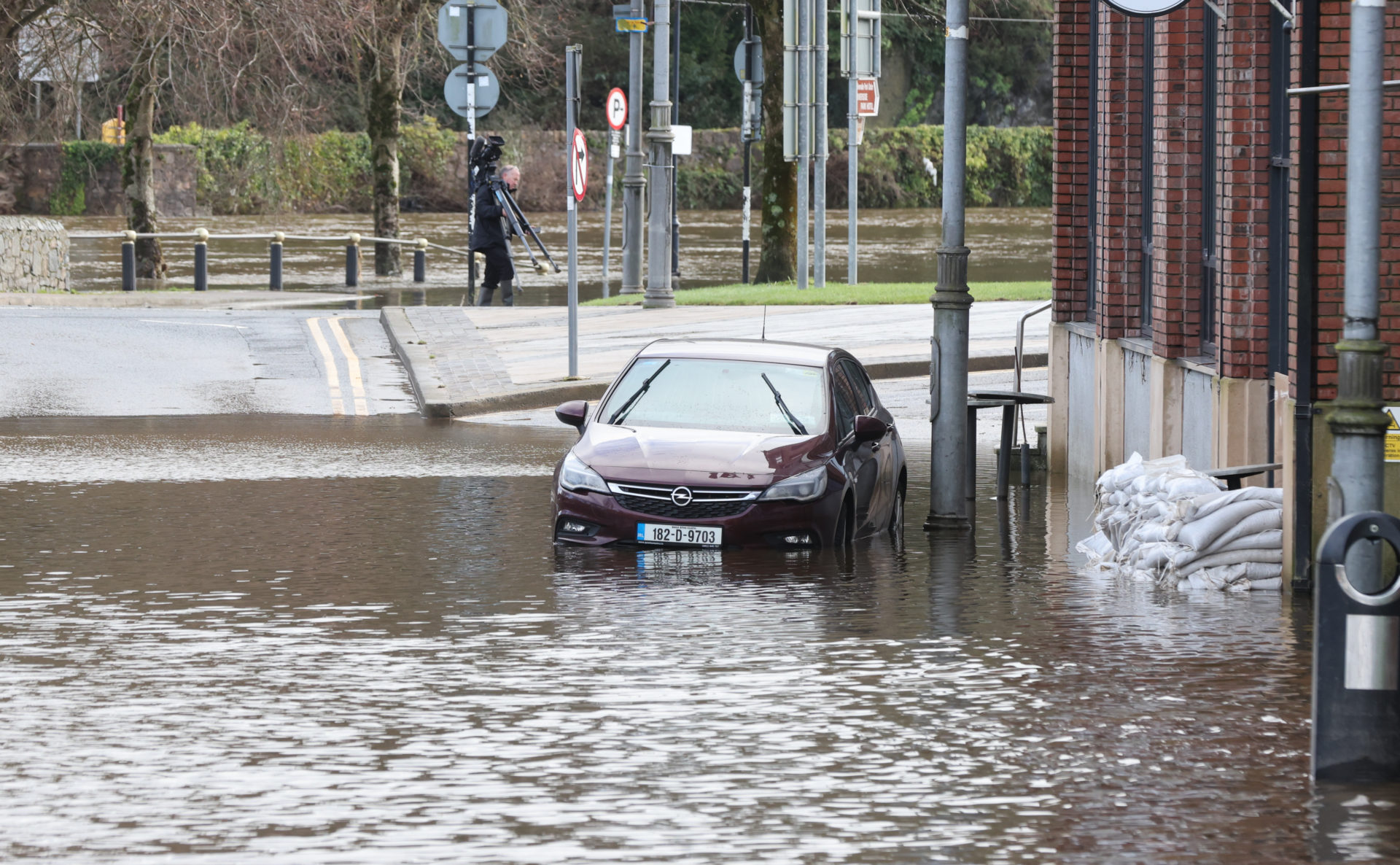 A car is abandoned in the flood waters on the Quays in Enniscorthy. Picture by: Eamonn Farrell.
He advised that, going forward Ireland should be looking to build and design infrastructures that will withstand conditions that could be seen in 2040 and 2050.
Amee Aimee Byrne, Assistant Professor in Civil Structural & Environmental Engineering in Trinity said that planning for climate change adaptation has to do with the type of flooding the territory is impacted by.
Fluvial is when rivers break their banks, pluvial which is rain based and coastal.
She noted Ireland is mostly impacted by fluvial flooding and pluvial flooding and that the real issue was with sustainable urban damage.
“What we need to do is try and increase the capacity of the local area to contain the water. We’d need green solutions and hard solutions,” she said.
She said next summer would likely see more heatwaves but that increasing green spaces, trees and canopy cover would protect from the rain fall and increase the rate at which it reaches the soil.
She also indicated that local governments should work on sustainable urban drainage and their involvement was detrimental to infrastructure change.
“What we need to do in rivers and what we are doing in rivers is we're looking further upstream and we're trying to prevent the water from the local landscape from going into the rivers in the first place.
“That would be things like introducing these kinds of small dikes, small kinds of let's say tree trunk based dams on streams, trying to block the flow from our peatlands into the River Liffey, for example.”
Main Image: Flooding sign. Picture by: Photograph: Sasko Lazarov.


