



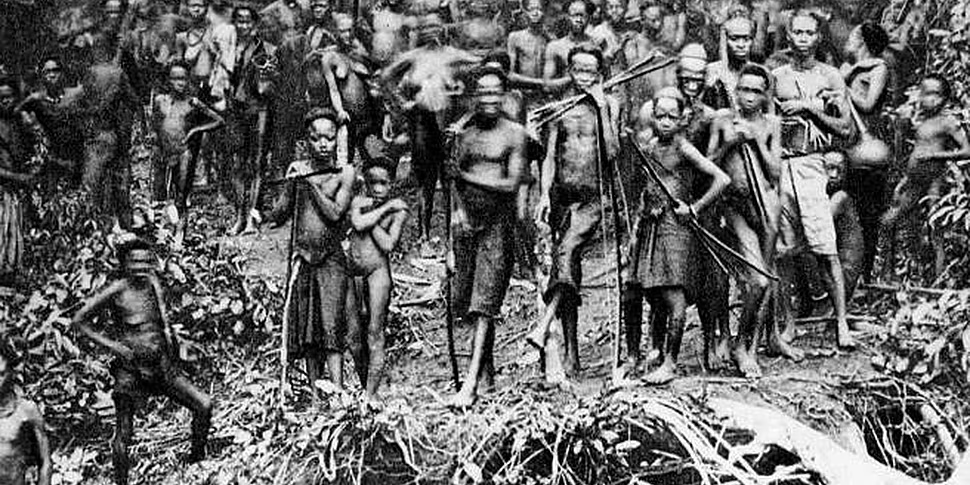
In 1899 imperialism was in full swing, the Congo was languishing under the brutal private rule of King Leopold II of Belgium, and Joseph Conrad’s phenomenal work ‘Heart of Darkness’ was published. An exploration of the nature of man and the maddening influence of power this novella has become one of the most discussed and analysed works in the English language. There was little fanfare around the work’s initial publication though, only becoming the revered classic it is now with time.
First published as a three part serial in ‘Blackwood’s Magazine’, ‘Heart of Darkness’ was largely based on Conrad’s own time captaining a steamer along the Congo River. Recounting his own experiences this work exposed the horrors of imperialism and the toll it was taking on the native people. The reader is drawn deep and deeper into the story as Charles Marlowe goes in search of the elusive Mr Kurtz; exposing a world being ravished by greed and power and the darkness that dwells within men’s hearts.
Since its publication ‘Heart of Darkness’ has inspired artists, authors, and filmmakers, been damned as a racist text, and generated heated debate. On this episode of ‘Talking Books’ Susan talks with Professor Cedric Watts and Dr Ida Corley about this evocative and controversial work. Should ‘Heart of Darkness’ be considered among the greatest works of English fiction? Was Chinua Achebe dismissal of it as a racist text fair? Does it offer an insight into the psychology of man? Or are we reading too much into a simple work?
 Northern Lights in Snowy Forest in Finland by Finnish Tourist Board
In recent times the Scandinavian nations have become the heroes for political and economic progressivism. Their attitudes toward gender and the family, public services, taxation, and workers’ rights have seen them dominate all three United Nations ‘World Happiness Reports’. They have also proved economically robust; remaining relatively untouched by the fallout from the Global Financial Crisis of 2007.
Though the advantages, disadvantages, resources, and identities of these nations are by no means uniform the success of the region itself has piqued the interest of leading thinkers around the world. The policies and economies of Denmark, Sweden, Norway, and Finland have been scrutinised and dissected in an attempt to uncover the secret of the Nordic success.
Rounding off this week’s show Susan talks with Dr Andrew Scott about his book, ‘Northern Lights’, and the lessons than can be gleamed from the Scandinavian success. Why are the Nordic countries considered such successes? How did these policies come about? What challenges do they face? And why should we try to follow or emulate their policies?
Tonight's music to read to
'Deportation/Iguazu', composed by Gustavo Santaolalla and featuring on the 'Babel Soundtrack', is the music Susan picked for the first part of the show while 'Seven' by Poppy Ackroyd, from her CD 'Escapement', is used to play out the show.


