



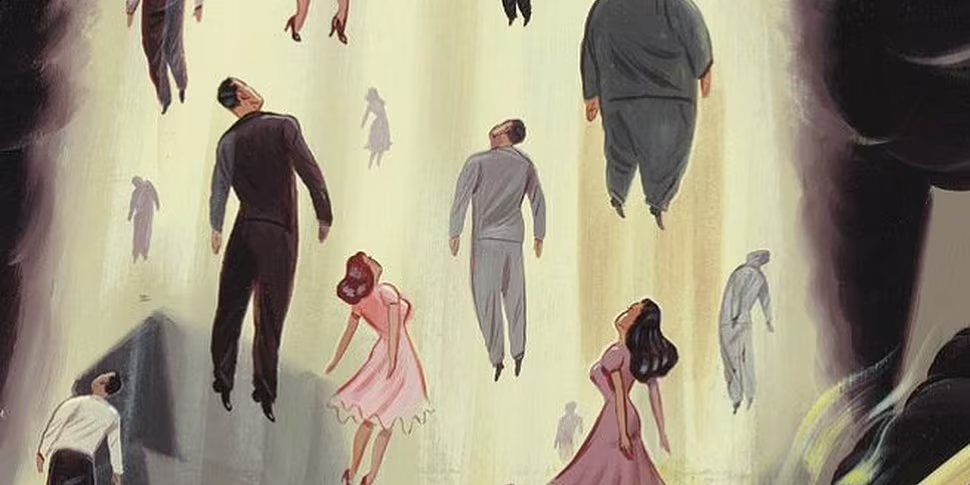
And I looked, and behold a pale horse: and his name that sat on him was Death, and Hell followed with him – Revelation 6:8, King James Bible
The idea that the world would eventually come to a climactic end reaches far back in human history. The Norse myth of Ragnarök details how the worlds of gods and man will be destroyed and then reborn in a series of epic clashes and events. Many branches of Hinduism have similar beliefs of celestial annihilation and recreation. The arrival of the New Testament brought a finality to this concept of apocalypse though as people were promised eternal reward or damnation based on their actions during life.
While the ‘Book of Revelation’ kept many of the compelling elements of the older pagan epics its fundamental shift toward finality brought a change in mindset. The history of Christianity is dotted with figures and movements that have foretold of the imminent arrival of the four horsemen and the cataclysmic battle between good and evil that they herald. The technological and communication revolution that started in the 19th century began a new chapter in this long history of doomsaying, one that took strong root in the USA.
The destruction of the industrial age and the radical changes in thought and taste during this period provided a convincing backdrop for the coming of the end of days. Total war and the modernist movement gave evangelical preachers powerful ammunition for their sermons. The increased interconnectivity of the late 19th and early 20th centuries also provided a means for them to reach out to their congregations and the wider public.
 'The Great Day of His Wrath' by John Martin, 1851
As the 20th century progressed and horror built on horror these evangelical congregations grew. Faced with the horrors of the Second World War, genocide, and the atrocities of the Cold War many Americans turned to religion and found solace in the promise of eternal heavenly reward. With nuclear annihilation a constant threat the claims that the world was coming to its promised close were far from unbelievable and the reach and influence of those preaching the path to the pearly gates grew.
The congregations of evangelical preachers swelled as America was assailed first by ‘godless international communism’ and later by terrorists. The corrupting influences of liberalism and government overreach were decried as tools of the Antichrist, a view that bolstered the conservative right. Some prominent religious figures turned to the airwaves to get their message heard and soon television and radio became key tools in the evangelical battle against evil. So great was the rise of evangelicalism during the 20th century that today it stands as a formative force in American politics.
In his book ‘American Apocalypse: A History of Modern Evangelicalism’ Professor Matthew Avery Sutton traces how the idea of the apocalypse transformed a small group of religious fundamentalists into an influential powerhouse. Join Susan this Sunday at 7am as she talks with Matthew about his book and how the fear of Armageddon changed, and is still changing, political life in America and abroad.
 Cover of 'Dept. of Speculation' by Granta Books
Rounding off the show Susan talks with acclaimed author Jenny Offill about her new novel, ‘Dept. of Speculation’, and its fantastic exploration of mundane everyday life. Shortlisted for the upcoming Folio Prize this novel eschews the strict storytelling format for a more fragmented style. Coupled with the absence of names for her cast this approach creates the impression that we are not being told a story but rather sharing in the narrator’s memories.
These pieces sketch out a vivid picture of an interesting yet everyday life. The reader becomes a voyeur as the narrator journeys through her life; negotiating marriage, parenthood, and the everyday realities of work, a career, and adulthood. While there are no dramatic twists or suspenseful turns the narration still manages to keep the reader enthralled. This is probably due to the honesty of Jenny’s writing. Excitement hasn’t been shoehorned in and the novel retains a strong air of honesty as a result.
The struggles with marriage and parenthood and the self-critical reflections of the narrator’s worth could be lifted straight out of real life. And they might well be, but the storytelling is so good that the illusion of the novel never really drops. ‘Dept. of Speculation’ never feels like a veiled memoir or confession. It is a humorous yet tragic window into the narrator’s life as a woman, a mother, a teacher, a wife, a writer, and a person.
Join Susan this Sunday as she talks with Jenny Offill about ‘Dept. of Speculation’, her life, and her writings. Why did she decide to write the book in this way? What lessons can we learn about relationships from this book? And how did Jenny’s life and experiences influence her writing?


