



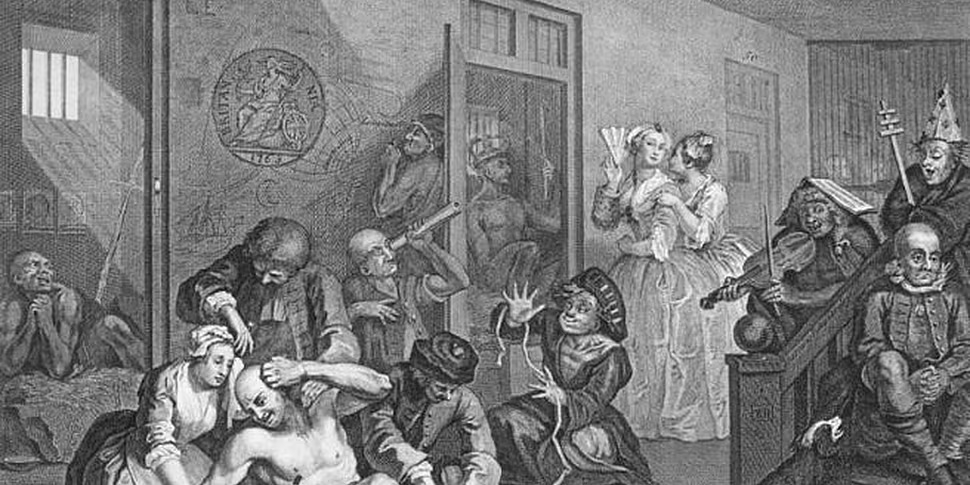
Mental illness has plagued mankind throughout our history. People sought cures and treatments for ailments from anxiety and melancholy to paranoia and hallucinations from before the rise of ancient Greece and Egypt. Our understanding of these conditions and how we have approached them change drastically depending on time and place. While the Greeks and Romans believed that these sufferings were caused by an imbalance in the bodies four humours while other cultures believed it was a spiritual malaise or caused by spirits.
In his latest book, 'Madness in Civilisation', Professor of Sociology and Science Studies Andrew Scull looks at how various cultures and civilisations have dealt with those considered to be irrational, psychotic, or insane. A great body off work this book traces changing practices, ideas, and attitudes from biblical times to modernity. Professor Scull shows details how treatments changed with societal and cultural norms and our 'understanding' of science, not always to the benefit of the patients. He also explores how 'madness' impacted on societies and the role it played in developing art, literature, philosophy, drama, and the other hallmarks of civilisation.
Join Susan as she talks with Professor Scull about 'Madness in Civilisation' and how our relationship with mental health has changed over time. What exactly is 'madness'? How has our definition of it and treatment for it changed over time? Are we in danger now of over diagnosing and prescribing? And are we much better and dealing with the mentally ill now than at other times in history?
 'Music' by Thomas Eakins, 1904
Music has often been seen as a relief for the suffering of the soul or the spirit. We have used it to mark solemn occasions, strike fear into our enemies, raise our hearts in joy, or lull us into peaceful slumber. Composer David Lang is one of the millions of individuals who have made music their life's work. In 2008, after decades of teaching and creating music, David was awarded the Pulitzer Prize for his piece 'the little match girl passion'.
Inspired by Bach's great 'St Matthew Passion' and based on the Hans Christian Anderson fable 'The Little Match Girl' this piece wowed audiences and established David as one of the foremost living names in the world of music and composition. There is more to us all than our job though and David has long been an adamant reader and lover of books as well as music. While most of the world knows him for his musical compositions the people of twitter follow him for his book recommendations and literary musings.
In the second part of 'Talking Books' Susan talks with David about his love of music and reading. Join us as we delve into the wonderful world of music and explore the effect it has on the human brain and soul. How does music affect us? Why are we so drawn to it? What role do books play in David's life? And why are they important?


