



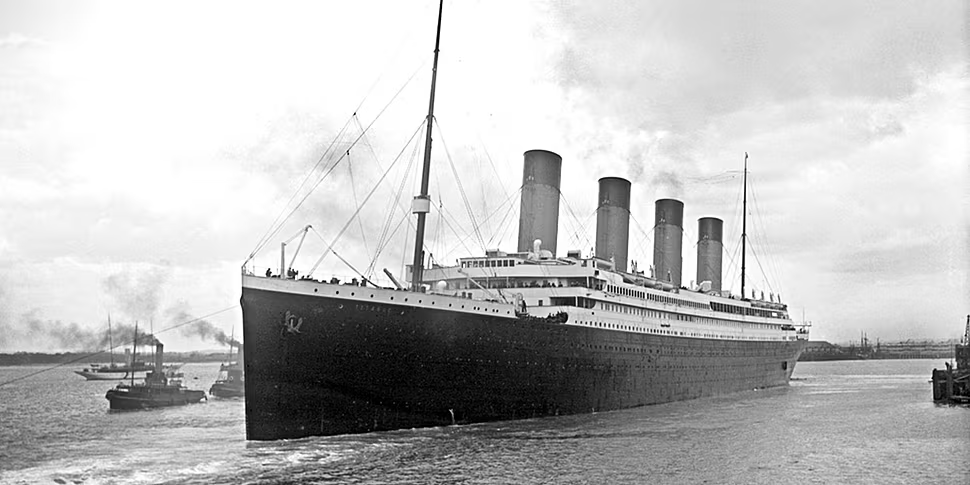
From the RMS Titanic to the Space Shuttle Challenger to the supersonic Concorde, catastrophic disasters have always been a fact of life, but could they have been avoided?
A new book by Devin Savage called The DNA of Disaster presents a groundbreaking framework for understanding why catastrophic failures occur and how we might avoid them.
In the book, he has what he calls "The Four Follies" and when he joined The Pat Kenny Show, he explained what they are.
He said: "The human folly number one [is] assuming the presence of intelligent design when only semi-intelligent design or no intelligent design is present.
"Intelligent design is something that is produced. It's something that's thought of by the human mind.
"It could be just a thought, or it could be something that's actually like, for example, this microphone here.
"It's, it's intelligent design. It would not exist without a human mind to conceive it and to build it.
"Then there's the operation of the thing and it's similar to the Titanic. I mean, you know, you've got a beautiful ship, but how does that ship operate? And the same thing goes with cars.
"Human folly number two is assuming the absence of intelligent design when it is in fact present.
"I call this the propaganda folly because of its use in history. An event in the past cannot be altered by decision-making. So we cannot alter the Titanic accident, disaster, whatever you want to call it.
"We cannot alter it from here, from this point in time. It's a fixture of the past. We can only alter how it is perceived.
"Now, for me, folly number three was that folly that you don't really know your machine well enough and you don't know how it should encounter the iceberg.
"And the final folly, misunderstanding the true nature of the universe; it's randomness.
"So, all the forces that we see that produce something like radioactivity or an earthquake or a volcano, those forces are not products of the human mind.
"Those are something that you can trace all the way back to the beginning of the universe."
In the case of radioactivity, he used the Curies as an example of this as they were handling radioactive materials and ended up suffering from radiation sickness towards the end of their lives.
They were researching something they didn't understand, and had no idea the ramifications it would have on their lives.
Essentially, as Mr Savage puts it: "[Folly four] is the unknown unknowns, as distinct from the known unknowns, or even the known knowns."
So, is there a way to avoid future disasters by learning from the catastrophes of the past?
Well, you can't always predict what's going to happen, but as Mr Savage says in the book, if you're going to build a city on the side of a volcano, "it helps to know something about the volcano".
He continued: "You really need to know your environment. I think the people who... the people in the government who have the actual power to make policy, they would be wise to read this book."
Main image: Titanic leaving Southampton in 1912 Pic: Alamy stock photo


