



Karl Deisseroth, Peter Hegemann, and Georg Nagel were jointly awarded the 2026 Nobel Prize in Physiology or Medicine for their pioneering discoveries concerning light-gated ion channels and optogenetics.
After a video of Nobel Prize winner Karl Deisseroth telling his family about his award went viral, a spotlight has been shone on the project that earned the accolade.
The Stanford University bioengineering and psychiatry professor, along with Peter Hegemann and Georg Nagel won the Nobel Prize in Physiology or Medicine for their new technology to study the brain.
But what does their technology do and what does it mean for people?
Thankfully, Luke O'Neill was on hand to explain all of this and just how mysterious the brain is to listeners of The Pat Kenny Show.
He said: "Now, the brain is the biggest scientific mystery still. We don't know how it works. There's all these things that we don't know about the brain.
"They invented a way to study the brain in living animals. It's a bit obscure.
"They put a protein in the brain that light could trigger and fire the brain through activating this protein.
"If you follow the logic there, it's light activated neurons and you can manipulate the mouse.
"They can learn things. They can have all these responses in response to light.
"It's a great story of basic research, actually, because Hegemann was working on these algae and he figured out that when they detect light, they're triggered by a protein on their surface and they move towards the light.
"They put that very same protein into a mouse's brain and light triggered the protein there as well.
"In this case, the triggering meant neurons and the brain firing. And the first thing they did, they stuck it in the motor cortex, shone light on it and the mouse's whiskers moved.
"So they could activate that part of the brain using light, you know. And now that's wonderful as a tool to study the brain."
As for how this new technology could help people, Prof O'Neill explained that it could be used to not only activate a part of the brain, but also switch something off.
For example, they put the protein into a blind man's retina and shone a light into the eye. The man reportedly said he could see a bit.
Also, in terms of switching things off, it could be a use to help stop epilepsy. IF you put the protein in the brain, and turn off the part causing the issues, it could stop epileptic seizures.
While it's still very early days in the research and usage, there are all kinds of applications that could come out of it.
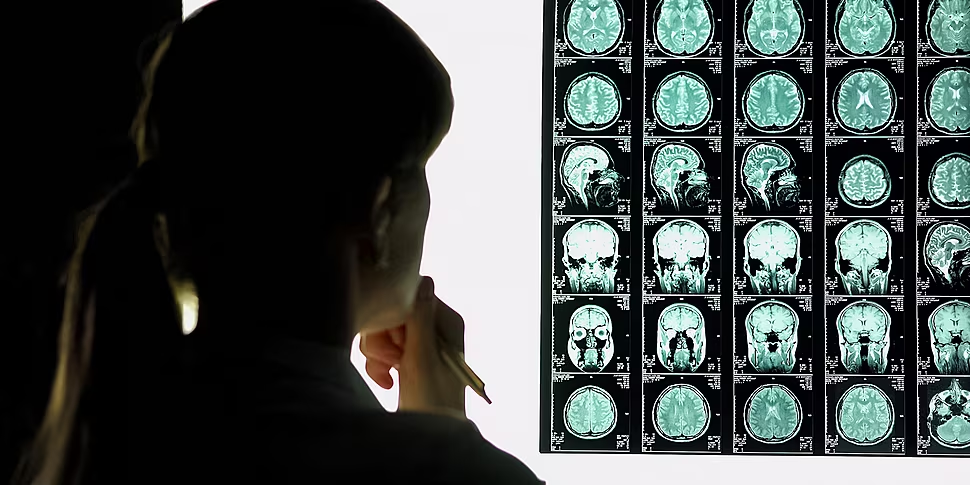
Main image: Doctor analyses brain scan Pic: Alamy Stock Photo


