


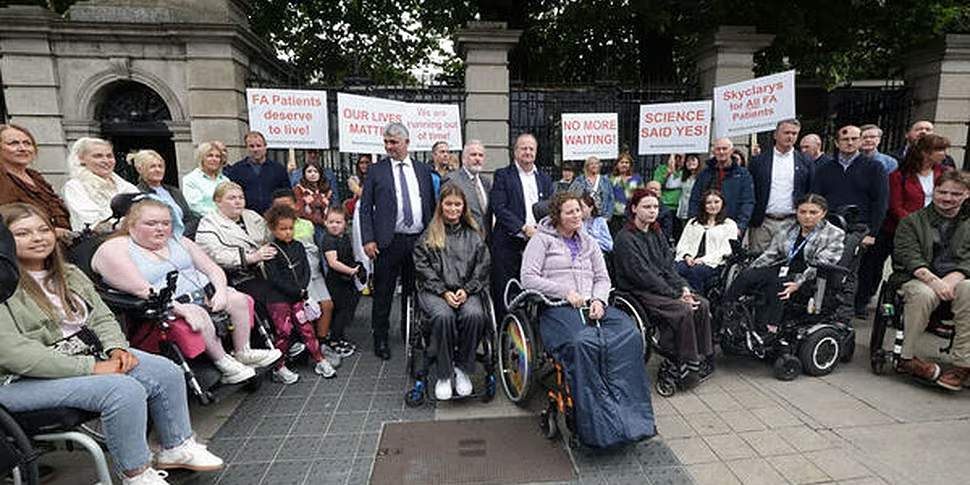
In a final appeal to the HSE, patients with Friedreich's ataxia took to the streets of Dublin to call for funding of the new drug, Skyclarys.
While you may not have heard of the condition before, you'll be hearing a lot about Friedreich's ataxia over the next few days.
Campaigners took to the streets of Dublin to plead to the HSE to change their mind on a drug that could help give those with the condition some respite from their symptoms.
There's around 200 people in Ireland living with the neuromuscular condition, and they are calling for the HSE to fund the drug Skyclarys which has been said to slow the progression of the disease, and would be life-changing for patients.
Jessie Abbey and her family were among those who gathered at the Garden of Remembrance on Sunday and shared how she wants to live for herself and her family.
She shared: "I don't want to get any worse, I don't want my voice to go, I don't want my hands, my muscles, everything to go. I want to be able to bring my little girl to school. I want to live for my nieces and nephews and my little girl."
Despite being approved in a number of European countries, the HSE has raised concerns over the treatment's clinical effectiveness and its price, estimating funding Skyclarys will cost at minimum €280,000 per patient per year.
On Friday's The Hard Shoulder, Ciara and Shane spoke to Dr Suzanne Crowe about the HSE's thought process behind not funding the drug, who shared that the decision is a stark reminder of the devastating human cost that can lie behind bureaucratic decisions.
She explained: "They [patients] know that their time is limited and this long drawn out, sometimes impersonal, it would seem, procedure is very hard on them. I have concerns that it's a very black box kind of approach for families.
"Families with any kind of rare condition are often aware of these medicines being developed well before any of the people working in health care, because, of course, they're tracking what's going on worldwide in terms of any kind of hope for any kind of drug that might help.
I think it's very difficult for families and often for staff to understand why you may not actually get access to the drug and why it takes so long to make a decision and really just raising the question, 'Are we really doing this the right way?' Perhaps there's a better way to actually approach this process.
"It's not a curative drug, but it is a drug that slows progression of a really terrible neurological condition.
"When you see people protesting outside the Dáil [with] heartbreaking accounts, you just wonder how is that weighted in the equation?"
She also explained how many of these drugs are designated by the European Medicines Agency as orphan drugs, meaning that the drug company says that they can't justify making the drug themselves in a cost-effective manner due to the small number of people with the conditions and need some government support to do it.
HSE is expected to make a final decision on funding Skyclarys on Tuesday, August 25.
Main image: Friedreich's Ataxia Press Conference outside the Dáil in Dublin city Pic: Leah Farrell/RollingNews


